In the global supply chain of minimally invasive dental technologies, laser-assisted treatment has transitioned from an advanced luxury to an absolute clinical necessity. While the core laser generator provides the specific wavelength energy, the clinical outcome is ultimately dictated by the distal delivery interface: the Dental Laser Tips.
For international medical device OEMs, dental service organizations (DSOs), and regional distributors, sourcing high-performance optical tips is not merely a matter of price procurement. It is an engineering auditing process where optical transmission efficiency, interface stability, and biological safety compliance intersect to determine the product’s total lifecycle value.
Materials Science: High-Purity Fused Silica Foundations
The core substrate of a premium dental tip determines its damage threshold and light propagation velocity. Subpar tips often utilize standard commercial-grade optical glass, which exhibits high internal attenuation and micro-impurities. Under high-peak-power dental laser loads, these impurities cause localized heat accumulation, leading to micro-fractures, beam distortion, and sudden intraoperative fiber burnouts.
Elite medical engineering mandates the use of high-purity synthetic fused silica. This material provides exceptional optical transmission from ultraviolet to near-infrared spectra ($200\text{ nm}$ to $2400\text{ nm}$). Consequently, it supports seamless energy throughput for Diode ($810\text{ nm} / 980\text{ nm}$), Nd:YAG ($1064\text{ nm}$), and Er:YAG ($2940\text{ nm}$) dental laser systems. The external cladding typically features a hard fluoropolymer or specialized silicone matrix, maintaining a high numerical aperture (NA) and preserving the beam’s spatial profile.
Mechanical Interfaces: Direct Insert vs. Screw Type Architectures
A critical decision in dental laser sourcing is choosing the appropriate mechanical coupling system. The connection interface directly impacts the speed of clinical setup, energy seal protection, and the lifespan of the delivery handpiece.
The Direct Insert Mechanism
Designed for rapid switching and maximum workflow efficiency, the Direct Insert interface utilizes a precision-machined shaft combined with high-durability medical-grade O-rings. This friction-fit engineering allows clinicians to swap tips between consecutive periodontal and endodontic procedures in seconds, preventing fluid contamination from entering the internal optics socket.
For an in-depth mechanical review of this quick-change system, explore our detailed analysis on the Engineering Optimization of Direct Insert Dental Laser Tips.
The Screw Type Architecture
For operations involving high-wattage continuous waves or high-frequency pulsed energy, structural stability is paramount. The Screw Type configuration utilizes ultra-precise micro-threads to lock the optical tip firmly into the handpiece housing. This mechanical lock completely eliminates axial movement caused by the sonic shockwaves generated during hard-tissue ablation, ensuring the laser beam remains perfectly aligned co-axially with the target tissue.
To review full threading specifications and torque resistance benchmarks, see our structural guide on Screw Type Dental Laser Tips.
Comprehensive Technical Sourcing Specifications
To simplify your technical procurement, the matrix below details the mechanical and clinical cross-compatibility parameters of our precision-engineered dental and surgical delivery components:
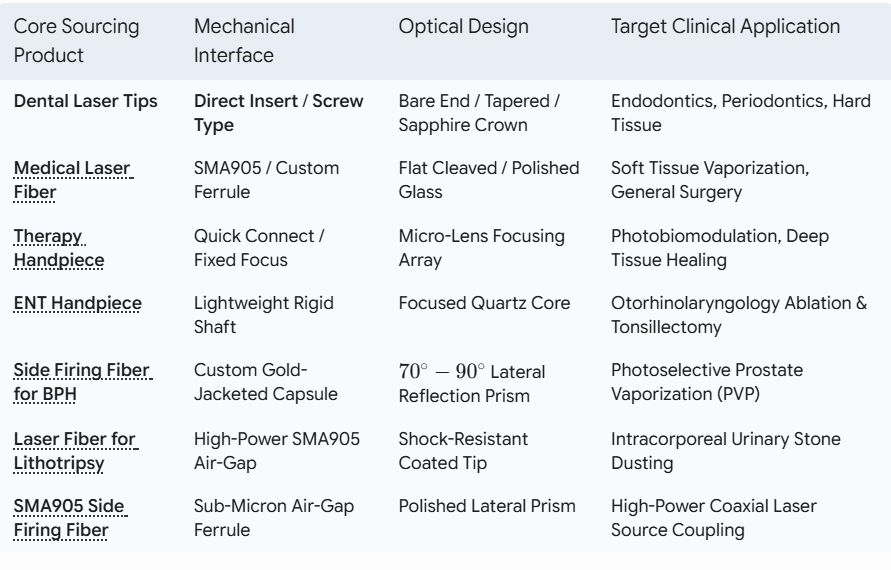
Clinical Interventions and Waveguide Adaptability
Modern dental laser practices partition treatments into three distinct categories, each requiring tailored tip geometries and structural strengths:
Endodontic Therapy (Root Canal Sterilization)
Root canal disinfection requires highly flexible, long-shaft tips capable of navigating tortuous canal systems. Optical fibers down to $200\,\mu\text{m}$ core diameters are utilized here. The energy must be distributed laterally to melt bacterial biofilms without perforating the apical foramen. This complex energy diffusion process leverages micro-lens technology similar to the advanced light guiding principles built into global sidefiber frameworks.
Periodontics (Soft Tissue Management)
Periodontal debridement and gingivectomy procedures demand robust, flat-ended tips that deliver concentrated contact energy. These tips must sustain high thermal thresholds during soft-tissue vaporization while maintaining clean, uncharred surgical margins. This high-load thermal control mirrors the strict design protocols required for high-power urological extensions, such as specialized Side Firing Fiber for BPH surgical lines.
Hard Tissue Cutting (Cavity Preparation)
Ablating enamel and dentin via Erbium lasers generates intense structural vibrations. Sourcing agents must verify that hard-tissue tips feature robust water-spray irrigation channel alignment. The quartz glass tip must withstand constant back-spatter and acoustic impact without cracking, matching the heavy-duty structural resilience found in industrial-strength Laser Fiber for Lithotripsy mechanisms.
Sourcing Conclusion: Minimizing the Total Cost of Ownership (TCO)
Sourcing cheap, uncertified dental optical tips introduces extreme operational risks: frequent tip fractures, damaged handpieces, inconsistent clinical energy outputs, and severe liability claims. Partnering with a vertically integrated manufacturer ensures consistent optical purity, standardized mechanical interfaces, and stable pricing structures. Optimize your supply chain by selecting premium-engineered dental waveguides that deliver reliable clinical outcomes and protect your laser equipment investments.