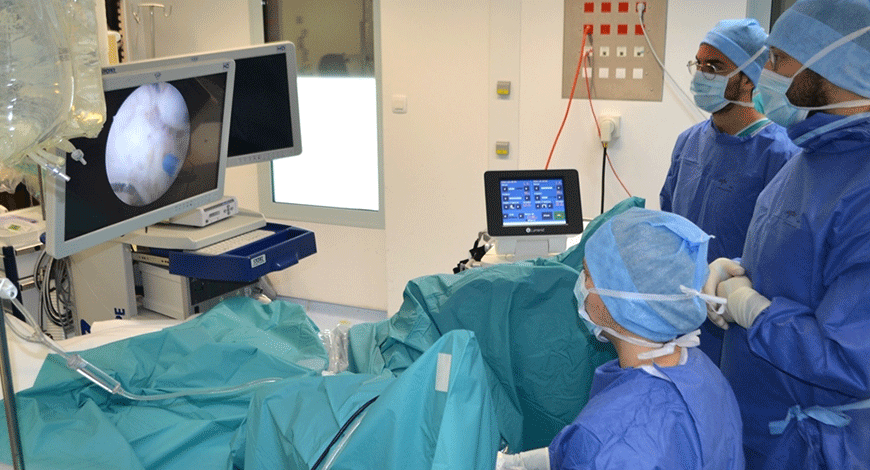
Thulium Laser Lithotripsy: A Step-by-Step Guide to Stone Dusting
For patients suffering from kidney or ureteral stones, and for the urologists treating them, laser lithotripsy has revolutionized care by offering a precise, minimally invasive solution. Among the latest advancements, the Thulium Fiber Laser (TFL) has emerged as a powerful tool, particularly praised for its efficiency in “dusting” stones into fine particles. If you’re wondering what is laser lithotripsy and how the thulium laser specifically performs this procedure, this guide will walk you through the essential thulium laser lithotripsy procedure steps and what influences the overall lithotripsy time.
Introduction: What is Laser Lithotripsy?
Laser lithotripsy is a medical procedure that uses concentrated laser energy to break down stones (calculi) in the urinary tract into smaller fragments. As a minimally invasive alternative to open surgery, it involves threading a thin laser fiber through a scope to reach and disintegrate the stone with minimal damage to surrounding tissue. For a
comprehensive understanding of the laser technology that powers this procedure, you can explore our detailed overview in the pillar article, Thulium Laser: The 2025 Ultimate Guide to Treatment, Wavelength & Medical Applications.
The Thulium Laser Advantage in Lithotripsy
The Thulium Fiber Laser operates at a wavelength (~1940nm) that is highlyabsorbed by water, a key component of both human tissue and stones. This allows for precise and efficient stone ablation. A significant benefit of TFL is its ability to operate effectively in “dusting” mode—pulverizing stones into tiny, passable debris—often with reduced stone retropulsion (the stone jumping away from the fiber) compared to some older technologies. Its high pulse rate capabilities can lead to faster stone ablation, directly impacting lithotripsy time
Step-by-Step: The Thulium Laser Lithotripsy Procedure
The following steps outline a typical retrograde intrarenal surgery (RIRS) using a thulium fiber laser:
Step 1: Diagnosis and Planning
Before the procedure, imaging techniques like X-rays or ultrasound are used to pinpoint the exact location, size, and density of the stone. This planning is crucial for determining the optimal surgical approach.
Step 2: Accessing the Stone
Under anesthesia, a thin, flexible instrument called a ureteroscope is inserted through the patient’s urethra and bladder and up into the ureter or kidney where the stone is located
Step 3: Laser Fiber Insertion and Positioning
A thin, medical-grade thulium laser fiber is passed through the working channel of the ureteroscope. The surgeon carefully positions the fiber tip in direct contact or very close proximity to the stone surface. The choice of fiber core diameter (e.g., 150µm, 270µm) is part of the strategic setup, much like selecting the right accessory for any advanced laser system, which you can read more about in our guide to Thulium Laser
peripherals
Step 4: Laser Activation and Stone Ablation (Dusting/Fragmentation)
This is the core of the procedure. The surgeon activates the laser, delivering controlled pulses of energy to the stone. Dusting: Using high frequency and lower pulse energy settings, the TFL can vaporize the stone into fine powder or “dust” that can be naturally flushed out. Fragmentation: For larger stones, a higher pulse energy setting may be used to break the stone into larger fragments first. The surgeon may use a device like a stone basket to stabilize the stone during lasing to maximize efficiency and minimize lithotripsy time.
Step 5: Fragment/Dust Removal
After ablation, small fragments and dust may be flushed out with irrigation or collected using a retrieval basket. The “dusting” capability of the TFL aims to create particles small enough to pass spontaneously.
Step 6: Post-Procedure Care
The scope is removed, and patients are monitored. They are typically advised to increase fluid intake to help pass any remaining stone particles.
What Determines Lithotripsy Time?
The total lithotripsy time is not fixed and depends on several key factors
Stone Characteristics: Size, volume, and composition are the primary drivers. Denser stones like calcium oxalate monohydrate (COM) ablate slower than uric acid stones. A study noted mean stone volumes could range from 750 mm³ for ureteral stones to over 2300 mm³ for renal stones.
Laser Settings and Technique: The surgeon’s choice between “dusting” and “fragmentation” modes, along with laser parameters (pulse energy,frequency, and average power), greatly affects the ablation rate and thus the procedure time.
Anatomy and Surgical Skill: Patient anatomy and the surgeon’s experience in maneuvering the scope and laser fiber proficiently contribute significantly to overall time.
Conclusion
Thulium laser lithotripsy represents a significant step forward in endoscopic stone treatment. Its precise wavelength and adaptable settings allow for efficient dusting, which can shorten lithotripsy time and improve patient outcomes by minimizing residual fragments. As with any medical technology, its effectiveness is part of a broader system. To fully appreciate how the thulium laser’s unique properties make this possible, including its specific wavelength and integration with other laser peripherals, we recommend revisiting the foundational concepts in our main pillar page, Thulium Laser: The 2025 Ultimate Guide.